How wonderful it is to know and believe that Jesus forgives our sins.
Jesus Christ wipes away the mess we make of our lives.
You can listen to today’s devotion by clicking this SoundCloud link.
“…and forgive us our sins, for we ourselves forgive everyone who is indebted to us.” Luke 11:4 English Standard Version
Over the next few days I will be using pictures that my grandson, Eli, has taken. I often ask Eli if he wants to take pictures with my camera. Most of the time his answer is “yes.” So I put the camera into program mode, place it around his neck, and set him loose. He doesn’t know what the aperture, shutter and ISO are, but he knows how to push the shutter button.
I love to look at the pictures he has taken when he hands the camera to me. I don’t assume to know what he was thinking when he took these pictures, yet in these blogs I will share with you what these pictures mean to me.
How wonderful it is to know and believe that Jesus forgives our sins.
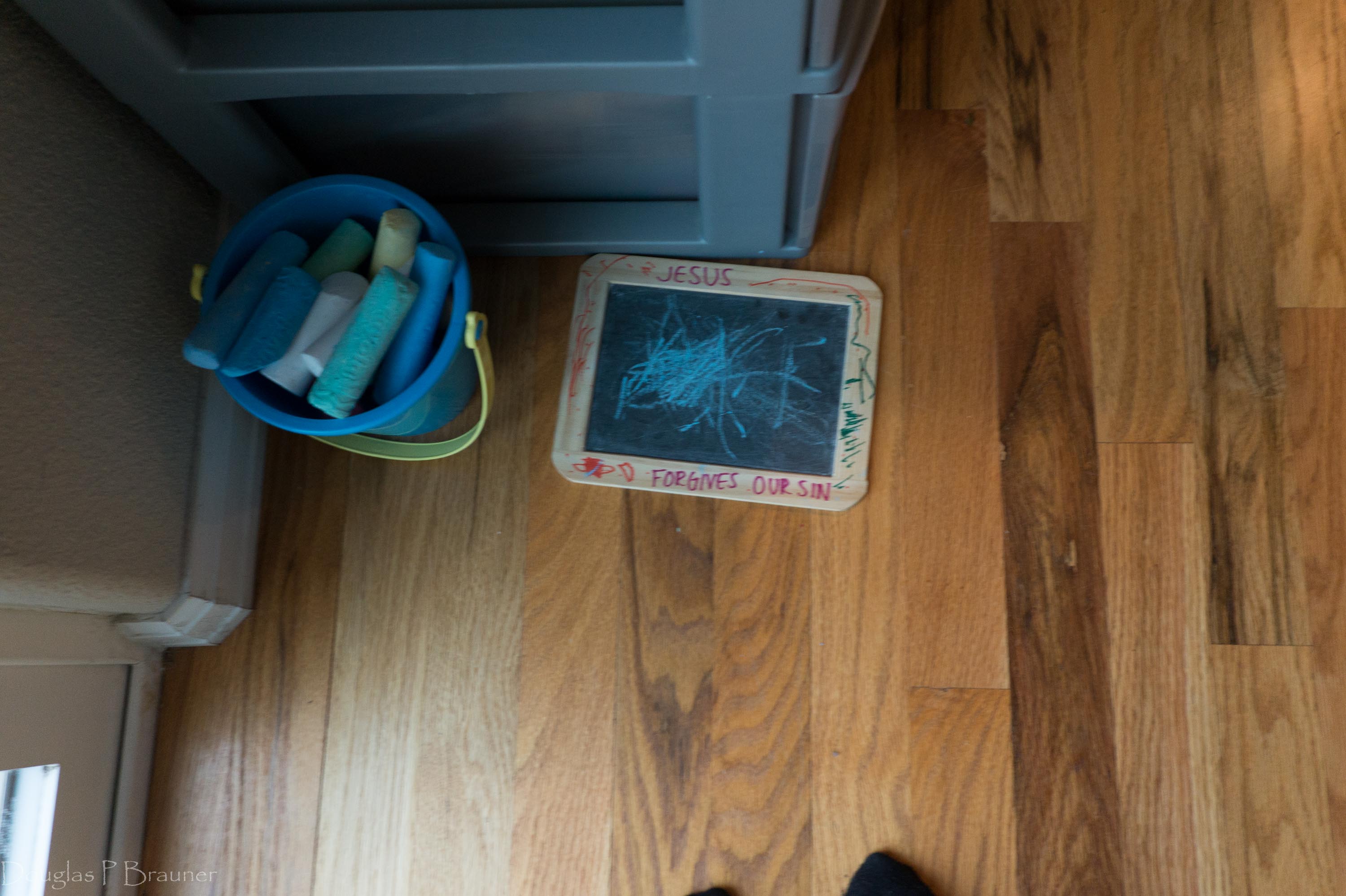
What better place to start than this picture of a small chalkboard surrounded by the words, “Jesus forgives our sin.” Besides these words I also noticed how close the chalk is to the chalkboard. Eli has captured a picture of forgiveness.
Whereas we have a way of messing up life, God excels at wiping our lives clean. Our attempts to fix our disasters don’t work.
I’ve created many disasters. As some of you know, my father was an artist. He loved to paint and draw. He didn’t need a ruler to draw a straight line. I’ve never drawn a straight line. I didn’t inherit my father’s ability to draw. What I did inherit is the ability to make a mess out of my life. In the church we call that sin.
God has done for us what we cannot do for ourselves. He has cleaned up our messes. He has wiped us clean by drowning our sin in the waters of baptism. Yes, “Jesus forgives our sin.”
And through this gift of forgiveness we are granted the power to forgive those who mess up our lives. I’m not saying that it’s easy to forgive, or that forgiveness happens instantaneously. We aren’t God. But through Christ and his mercy for each one of us we are granted the ability to forgive others as we have been forgiven.
Text Copyright Douglas P Brauner
Picture Copyright Eli Brauner
The Lord’s name is praised no matter how arduous the day.
You can listen to today’s devotion by clicking on this SoundCloud link.
Praise the LORD! Praise, O servants of the LORD, praise the name of the LORD! Blessed be the name of the LORD from this time forth and forevermore! From the rising of the sun to its setting, the name of the LORD is to be praised! The LORD is high above all nations, and his glory above the heavens! Who is like the LORD our God, who is seated on high,
who looks far down on the heavens and the earth? He raises the poor from the dust and lifts the needy from the ash heap, to make them sit with princes, with the princes of his people. He gives the barren woman a home, making her the joyous mother of children. Praise the LORD! Psalm 113 English Standard Version
Depending on whether you’re a morning person or a night owl, we love sunrises or sunsets. And for those insomniacs among us, we love both. Photographers call the time just after sunrise and before sunset the golden hours. It’s the time when the light is the richest and the photographs the most appealing.
A beautiful sunrise sparks a hope-filled alpha to the day.
A dazzling sunset mends a hope-dashed omega of the day.
At the end of the movie, Hope Floats, when the sun has set and fireworks fill the sky, Birdee Pruitt quotes her mom. “Beginnings are scary. Endings are usually sad. But it’s the middle the matters the most.” The beginning of the day might bring fear and the end of the day sadness, yet its the grinding out of of every minute that matters most.
The psalmist reminds us that from the beautiful sunrise to the dazzling sunset, our true work is to praise the person and work of God. Why? Because it is God who gets his hands dirty during the sweat-filled twenty-four hours of each day.
He raises the poor from the dust.
He lifts the needy from the ash heap.
He gives the barren woman a home.
Hope for each day floats up in praise to the Lord because each day his mercy falls down to his people. So enjoy the sunrise and the sunset knowing that between the two, the Lord is laboring for you.
Faith in God’s word of promise takes us from despair to hope.
(Note to the reader: The following blog was recorded as a homily for KFUO radio’s His Time. KFUO is the radio station of the Lutheran Church-Missouri Synod. It will air on August 3, 2016. I will also discuss this text with host, Andy Bates. You can stream this conversation by going to www.kfuoam.org at 7:00 am MDT. If you miss the live conversation you can listen to it in the KFUO archieves by clicking on this link: His Time.)
Much time had been lost, and sailing had already become dangerous because by now it was after the Day of Atonement. So Paul warned them, “Men, I can see that our voyage is going to be disastrous and bring great loss to ship and cargo, and to our own lives also.” But the centurion, instead of listening to what Paul said, followed the advice of the pilot and of the owner of the ship. Since the harbor was unsuitable to winter in, the majority decided that we should sail on, hoping to reach Phoenix and winter there. This was a harbor in Crete, facing both southwest and northwest. When a gentle south wind began to blow, they saw their opportunity; so they weighed anchor and sailed along the shore of Crete.
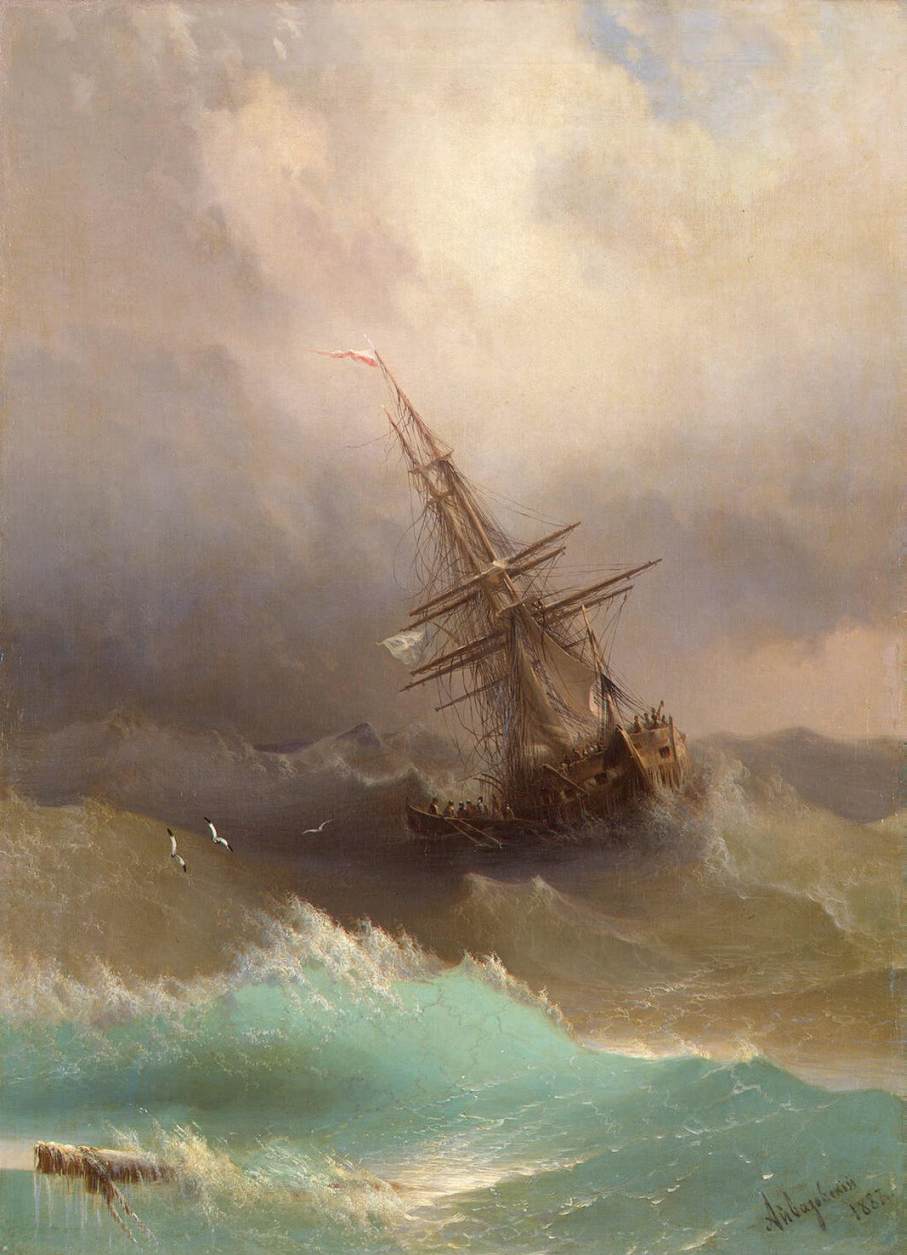
Ship in the Stormy Sea, by Ivan Konstantinovich Aivazovsky, 1887
Before very long, a wind of hurricane force, called the Northeaster, swept down from the island. The ship was caught by the storm and could not head into the wind; so we gave way to it and were driven along. As we passed to the lee of a small island called Cauda, we were hardly able to make the lifeboat secure, so the men hoisted it aboard. Then they passed ropes under the ship itself to hold it together. Because they were afraid they would run aground on the sandbars of Syrtis, they lowered the sea anchor1 and let the ship be driven along. We took such a violent battering from the storm that the next day they began to throw the cargo overboard. On the third day, they threw the ship’s tackle overboard with their own hands. When neither sun nor stars appeared for many days and the storm continued raging, we finally gave up all hope of being saved. After they had gone a long time without food, Paul stood up before them and said: “Men, you should have taken my advice not to sail from Crete; then you would have spared yourselves this damage and loss. But now I urge you to keep up your courage, because not one of you will be lost; only the ship will be destroyed. Last night an angel of the God to whom I belong and whom I serve stood beside me and said, ‘Do not be afraid, Paul. You must stand trial before Caesar; and God has graciously given you the lives of all who sail with you.’ So keep up your courage, men, for I have faith in God that it will happen just as he told me. Nevertheless, we must run aground on some island.” Acts 27:9-26 New International Version
My family and I moved from Oregon to Colorado seventeen years ago. Having family back in Oregon we knew that there would be numerous trips back and forth between the two states. There are miles upon miles between cities when making this journey. Since I drive well-seasoned cars, these trips have the potential of turning into adventures.
My wife and I were on our way back from Oregon and were hoping to make it from Portland to Ogden, Utah when our trip became and adventure. Our car died between Burly, Idaho and the Utah border. You’d think that if you drove vintage cars you’d have some mechanical expertise. I have none. So as not to look totally incompetent to my wife, I lifted the hood, pulled on cables and grunted a few times hoping that I might accidentally fix the problem.
Needless to say, we spent the next day in Burly. Car problems can lead us to despair.
We might define despair through the eyes of the 276 people onboard ship with Paul. It’s dangerous to sail the waters of the Mediterranean from September to mid-November and suicidal after November.
It’s sometime in October, after the Day of Atonement, when the ship’s pilot and its owner, along with the majority of the passengers, decided to set sail. Disregarding Paul’s advice to stay at Fair Havens on the island of Crete, they leave when a gentle south wind catches their attention. What does Paul know about sailing? The ship’s pilot had more experience and the owner wouldn’t put his boat at risk, would he?
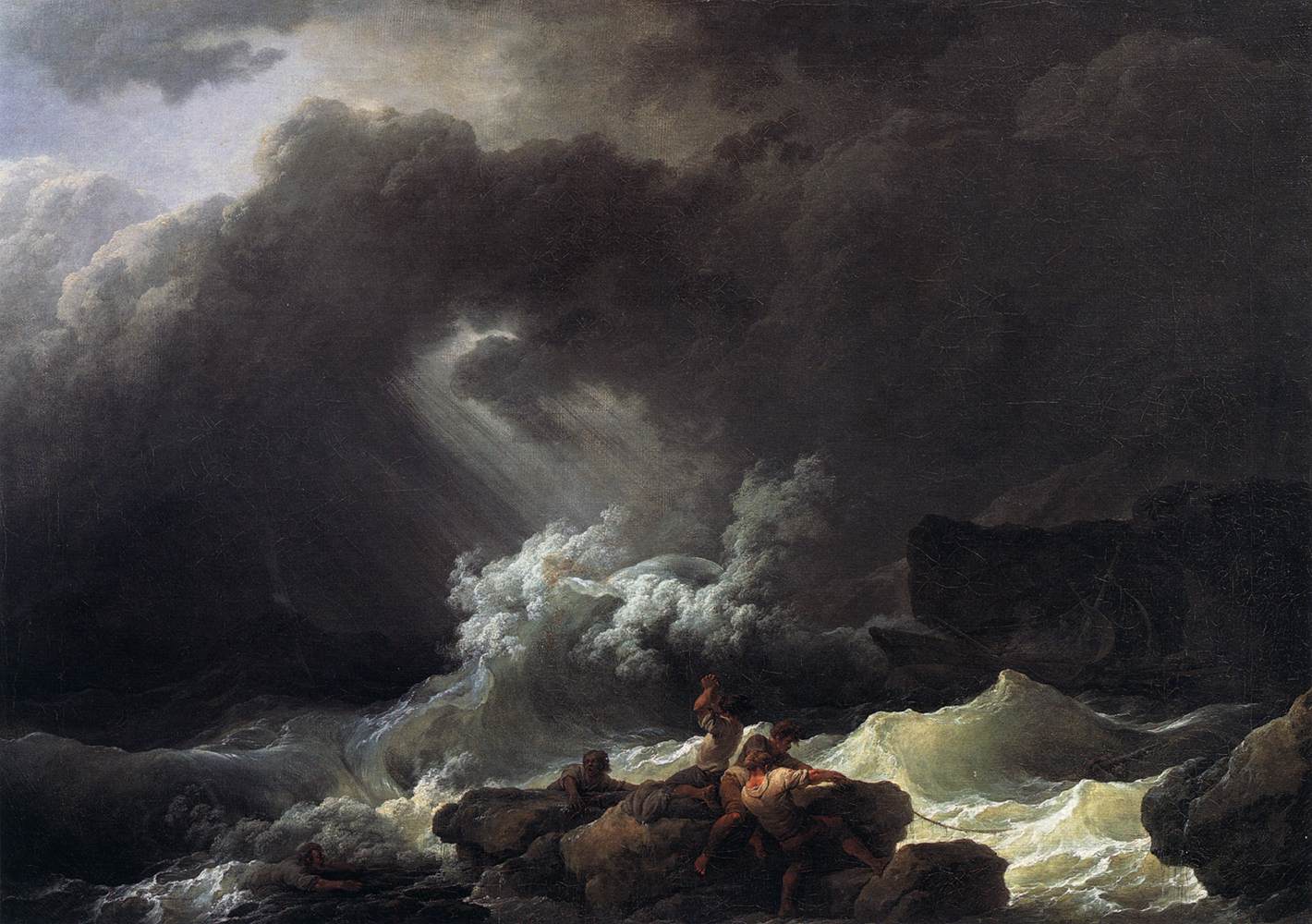
Shortly after rounding Cape Matala, a gale force wind from the northeast strikes the ship. The storm, traveling over Crete, pounds the ship for fourteen days before it shipwrecks. In those fourteen days the sailors and passengers did everything they could to save themselves. Having secured the dinghy to the deck, they bind the ship with ropes. Fearing that they might drift into the rocks and sandbars they lower the gear. They throw the ship’s cargo and tackle overboard.
Luke describes their state of mind when there’s nothing left for them to do. At the end of verse 20 he writes that, “all hope of being saved was at last abandoned.” Like the tackle and cargo, they throw their hope overboard.
Shipwreck, by Philip Jacques de Loutherbourg, 1767
It’s important to note that Luke doesn’t mention what Paul did during these days of torment, but finally he stands in the midst of everyone and delivers the greatest, “I told you so,” of the Bible. “You should have listened to me,” he states. However, instead of turning away and sulking somewhere on the ship, Paul speaks words of hope. “Now I urge you to take heart, for there will be no loss of life among you, but only of the ship.”
Paul’s words are the turning point in the story. In the midst of the storm the people believe Paul. They had no physical evidence that they’d be saved. They trusted the word and sail on. And though the ship is wrecked not a life is lost.
There are times that we are driven to despair by the storms of life. We do all that we can to survive, but nothing works. We try to fix our friendship, only to make the problems worse. We try to fix our marriage but our spouse doesn’t want anything to do with our fix. Our attempts to fix our lives might leave us tempted to abandon hope.
In the midst of the storms we see Jesus standing among us and his word of promise spoken. A word of promise that tells us that he will be with us always no matter how badly the storms rage. His word of promise that tells us that there is nothing that can separate us from his love. His word of promise that tells us that our sin-filled failures are forgiven through the mercy of his blood shed for us.
The journey of faith in the promises of God is a journey from despair to hope, a hope that will never disappoint because it’s rooted in the crucified and risen Christ.