The parable of the Good Samaritan teaches us what it means to be neighborly.
Which of these three, do you think, proved to be a neighbor to the man who fell among the robbers?” He said, “The one who showed him mercy.” And Jesus said to him, “You go, and do likewise.”
Luke 10:36-37 English Standard Version
Five Dallas, Texas police officers were shot and killed and seven other people were wounded on Thursday, July 7. Police killed the assailant whose motive was anger. It’s interesting that the parable of the Good Samaritan was the reading for the Sunday after this shooting and the shooting of two African-American men in Minnesota and Louisiana by police officers.
How do we read this story in light of what has happened?
Our tendency is to go directly to the “moral of the story,” to proclaim loud and clear that we ought to “go and do likewise.” I understand that reading of the text. Jesus does exhort the lawyer, as well as the reader, to show mercy as the Good Samaritan showed mercy. In reading the text we’re encouraged to walk in each other’s shoes and not make assumptions about people who are different. We are encouraged to show mercy to people that we might consider our enemies.
But is this the best reading of the text when we consider the state of the world today?
There might be some of you reading this blog thinking that there is no other way to understand the parable of the Good Samaritan. Jesus tells the lawyer to go and show mercy. It’s not that I disagree with this conclusion, but we often miss the road we take to get to this point of showing mercy.
In preaching on the Good Samaritan this past Sunday (July 10, 2016), I used a picture of Vincent van Gogh’s painting, The Good Samaritan. Van Gogh actually copied the work of Eugene Delacroix some 40 years earlier.
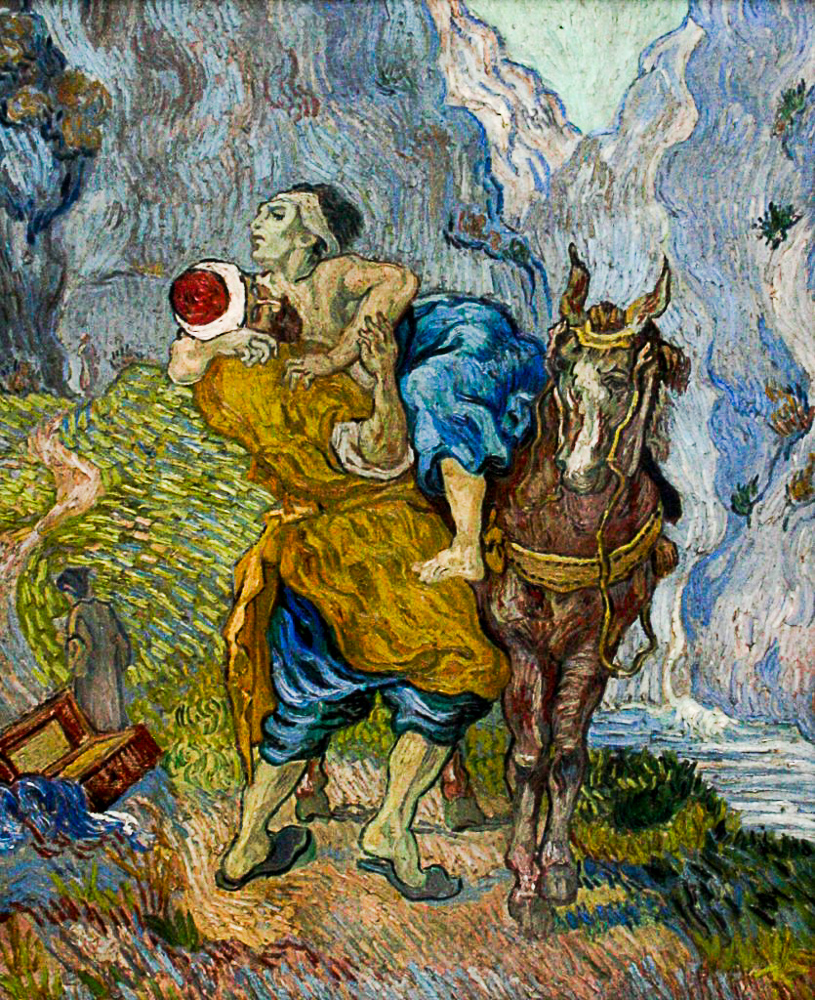
Different than other depictions of the Good Samaritan, van Gogh paints the Samaritan and the wounded person in mid action. The beaten man is not laying on the ground nor already seated on the horse. Instead, the Samaritan struggles to put the wounded man on his horse as his weight rest on the Samaritan’s body. His legs push upward, his back bends, his arm extends, his eyes roll backwards from the strain. There is nothing easy about placing this beaten man on his own horse.
There is a great deal of pain in showing mercy. How can someone truly be empathetic and care for the hurt of another person without hurting? When someone listens to the pain of another person it enters their soul and dangerously lingers there, sometimes to the point that the caregiver can’t stand the pain. Maybe this is why Jesus says, “Blessed are the merciful, for they will receive mercy.” (Matthew 5:7) The person who shows mercy is often in need of compassion.
 The Samaritan is not the only figure in the parable who bears the burden. The horse also carries the unnamed victim. The horse steadies itself to receive its new rider. The Samaritan and horse share in the suffering of the wounded man. All three are bloodied by the blows of the highway bandits. Mercy is expressed in the context of community. In his last words to the Galatians Paul writes, “Make it your way of life to bear each other’s burdens and in this way fulfill Christ’s law.” (Galatians 6:2) The law of Christ is his law of love. Love is fulfilled when we bear each other’s burdens. Paul’s words are addressed to the community, not the individual. Speaking Texan, Paul would have written, “All you all.” Mercy is not merely the action of the individual but of the community that follows Christ.
 Two figures blend into the landscape hardly noticed by the viewer. The priest is about to disappear from the painting and be absorbed into the mountain. The Levite is depicted with his back to the this act of mercy, appearing behind an open box which must have carried the wine, oil and bandages. There is no color, no life in these two men. They have refused to be merciful and so deprive themselves of the experience of mercy. Without mercy life is only different shades of gray. A Christian community that doesn’t practice mercy misses the variety of color on God’s palette.
However, is this emphasis on doing mercy the heart of the parable of the Good Samaritan? Let’s look at the story in its context.
The lawyer began this encounter with Jesus by asking the question, “What shall I do to inherit eternal life?” In response to the lawyer Jesus asks him, “What’s written in the law? How do you read it?” The lawyer astutely answers, “Love God…Love your neighbor…” To which Jesus say, “Great! Do this and you will live.”
Though the lawyer had tried to trap Jesus, he now senses that he is about to be trapped. “And who is my neighbor?” Magnificent come back, right? However, Jesus changes the question without the lawyer noticing. Through telling the parable the question now becomes, “What does it mean to be a neighbor?” So, Jesus asks another question, “Which of the three proved to be the bloodied man’s neighbor?” There’s only one answer, “The guy who was merciful.”
“Go and make this your lifestyle,” Jesus responds.
In other words, if you want to do what it takes to earn eternal life, you must do exactly what the Samaritan did every minute of every hour of every day. This is Jesus’ point. Too often we remove Jesus’ last words from the context of his encounter with this lawyer. The lawyer asked what HE could do to inherit eternal life. Jesus shows him that there is nothing he can do.
In essence, the story is about the One who is both our Good Samaritan and the man beaten on the road.
Hope of eternal life, and the experiencing of that life now, is found in the One who was bloodied by our sin. We killed Jesus. All of humanity killed Jesus. I killed Jesus. Yes, I killed him with my sin. He wasn’t left for dead, he was dead.
Yet, through his resurrection he has become our Good Samaritan, for we too have been bloodied by our rebellion against God. At great cost Jesus has healed our wounds, pouring on us not oil and wine, but his shed blood.
Mercy comes in the form of an empty cross.

The meaning of the parable of the Good Samaritan is found in the mercy we have received from Jesus, and the hope that we receive from his mercy. For this reason, the parable of the Good Samaritan speaks to what we’ve been experiencing in our communities and in the world.
God’s mercy is not only given TO us, it is given THROUGH us. It is the mercy of God that works in us to love both our best friends and our enemies. It is the mercy of God that allows us to weep both with the families of the slain police officers and the families of the men who were killed by officers. God was not selective in his mercy poured out from the cross. In compassion he died for you and me, for Jews and Muslims, for Christians and atheists. Mercy cannot be selective when that mercy is rooted in Jesus.
There will be more incidents like those in Texas, Minnesota, and Louisiana. People will hate, steal and kill. Sin is real and its presence is felt through the brutality of humanity. Some of these events will be far removed from our lives and others will reside in our homes. May we see Jesus active in those places of inhumanity. And may the Holy Spirit empower us with his mercy, even when that mercy hurts to the core of our being.
Copyright Douglas P Brauner
+