Photo: https://goo.gl/VuZLya http://creativecommons.org/licenses/by/4.0/
Asking Big Questions about Denominationalism Doesn’t Mean Receiving Big Answers
There are some things you need to know about me if you’re going to keep reading the words I have to write. I ask a lot of questions that I don’t have answers to. I want to blog those questions without a wrap-up paragraph that brings it all back to a certain story or Bible verse because it would ring false. Likely, you’ll have more questions at the end than when you started.
Also, I’m not a theologian. I am not trained in spiritual matters. I’ve had little instruction in how to read and use my bible. That said, all instruction I’ve had has improved my bible reading experience and understanding.
I do have big, fat questions. One of the chunkiest is the question of denominationalism. Why, WHY are we a church divided? Simple, obvious answer: Because we’re a sinful people and the devil uses all of his resources to delay and derail the spreading of the message of God.
But, if we rightly believe God does all for the good of his people (Romans 8:28 “ And we know that in all things God works for the good of those who love him, who have been called to his purpose.”), could He also have a reason? With my most benefit-of-the-doubt thinking, I wonder if all our denominations and all their differences could bring glory to the kingdom because we reach vastly different individuals with our ways of sharing the most important message.
I wonder about the early church. I wonder how important those early traditions were and how they could be left behind. I wonder about our present churches, so many of them breaking free of everything but the most basic of basics: the bible and the message that we are saved by the grace of our Lord Jesus Christ and His sacrifice of all sacrifices.
John 3:16-17 “For God so loved the world that he gave his one and only Son, that whoever believes in him shall not perish but have eternal life. For God did not send his Son into the world to condemn the world, but to save the world through him.
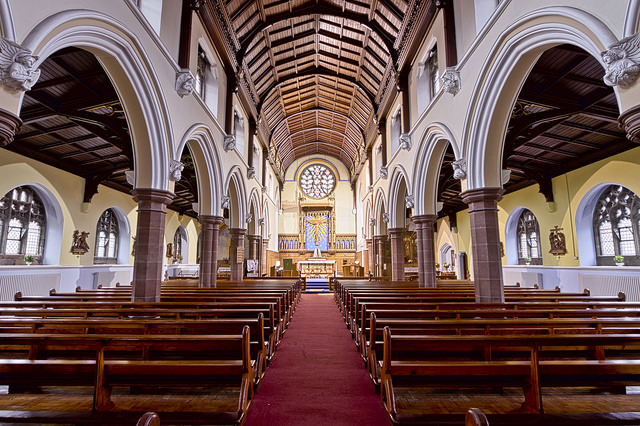
They are on opposite sides of the spectrum when it comes to style and there are a lot of substance differences too. Can they both be right? Can they both be Christian? Do members of both kinds of churches and all Christian denominations REALLY go to Heaven?
 Here’s the thing. I think they do. I think that Jesus extends so much stinking grace and He works through so many ways that anyone who follows Him as the way the truth and the life (John 14:6 “Jesus answered, ‘I am the way and the truth and the life. No one comes to the Father except through me.’”) will see Him again in the place He has prepared for us (John 14:2-3 “In my Father’s house there are many rooms; if it were not so, I would have told you. And if I go and prepare a place for you, I will come back and take you to be with me that you also may be where I am.”).
But I also lean towards thinking there is a right way. Or at least a pyramid of right ways. Some ways more right than others, some barely right?? A structurally unsound pyramid…
This is an especially personal topic for me. I grew up sorta-Catholic. I had many non-Catholic major influences in my childhood and adolescence – Lutheran and Methodist mainly. I explored the world of non-denominationalism in college before I met Colin (now my husband) and explored the Missouri Synod Lutheran church in which he grew up. I agreed with everything I learned in our first church together and was confirmed as a Lutheran before we got engaged.
Since then we’ve attended LCMS churches wherever we’ve lived, which has taught me that no church does things exactly the same and that some churches focus on different aspects of the Lutheran tradition as most important. If that doesn’t send a girl church shopping, what will?
Even within our family now we have denominational tension. We don’t all go to LCMS churches anymore. We crave acceptance and understanding from each other as we worship the ways which we believe are acceptable. But it’s a stress on all of us. We all crave truth and we all like being right and we struggle to open our minds and hearts to real truth even if it were to punch us in the throat. (Although I’m not sure that’s in God’s usual repertoire.)
What is right? What is acceptable? Are those two different questions? I can only assume that real theologians have asked those questions for centuries. I bet there are hundreds of books on the topic. I may even look into them. But I’m a sceptic. Because I know what I’ll find: contradiction. Contradiction that points to the author’s church as the right one. You’ve had those thoughts before? You’ve been twice burned, eh? Me too.
This is a good argument for fundamentalists who rely only on the inerrant Word of God as their text. Yet there are topics on which God seems silent. So what about those? And who is capable of reading the bible with spiritual discernment? Who is capable of preaching it?
Let me take a second to interject some advice my mother-in-law gave me a few years ago when faced with stumbling blocks or questions from non-believers that I’m unable to answer. Use the phrase “I don’t always know WHAT I believe about this or that, but I know in WHOM I believe.” And it’s the truth. Sometimes I face tough questions but my faith in JESUS never falters. I believe there are some things I’ll never have answers to and I’m okay with it. I think asking those questions leads to spiritual growth.
If we Christians are all equal is there a benefit to going to one church over the other? Is the benefit familial peace when you remain in the same denomination for generations because it’s easiest? Is the benefit different levels of understanding that come with different styles and substances of a church? Is the benefit, as I suggested as a possibility earlier, reaching all God’s creation in different manners? The cost feels high though, doesn’t it? Fighting, disagreeing, showing non-Christians our inherent division?
I want to believe I could worship at any kind of Christian church wherever I happen to be any given day or year of Sundays. Yet I know it’s not true. I really do believe in the significance of infant baptism and the presence of Christ in the sacrament of communion. I treasure the liturgy in every church service I attend, even if there are differences within it, and I can’t imagine not confessing a creed of the Christian church every week. These beliefs differ from many of my Christian friends’ beliefs and for the most part they’re left out of the conversation altogether. Why? Why leave these treasures out? If I believe they’re right, should I be trying to subtly (or not so much) convince my loved ones of the rightness of my Christian denomination over theirs? That doesn’t quite seem right either though, huh? I leave the nuances of my Lutheran faith out of the conversation because, grand scheme, big picture, I believe Christians go to heaven.
I don’t know how many people are out there right now on the verge of coming to Christ and get tripped up on these sorts of questions and never move further in the faith. I don’t know how many people are out there right now who have left the church because they weren’t allowed to ask the big questions. 1 Thessalonians 5:19-21 “Do not put out the Spirit’s fire; do not treat prophecies with contempt. Test everything. Hold on to the good.”
It’s a question I will keep asking. And this post is dotted with questions marks, proving there are many questions within it. I believe God will answer me if it’s His will that I know the answer. I pray that I will have the faith and discernment to understand if He does. I’m thankful to be surrounded by faithful Christians on this journey of faith that will be complete when Christ returns to earth. Come, Lord Jesus.
____________________________
Katie Engebretsen is wife to Colin and mother to Ethan, Elise, and Liam. She is a military wife and a native Minnesotan. She has a passion for life-long learning and connecting with every person she meets. Her hobbies include reading, writing, and singing in the car. Katie and her family have been attending Holy Cross Lutheran Church since 2014.